Pointe du Lac plantation
Interview with the VampirePointe du Lac plantation is the Louisiana estate that anchors Louis’s passage from mortal landowner to vampire. Set near New Orleans on the Mississippi River, it joins family inheritance, indigo production, enslaved labor, concealed wealth, and supernatural secrecy in one space. For Louis, the plantation is at once a beloved home, the site of Paul’s death, the property Lestat covets, and the identity Louis ultimately burns away.
Setting and Material Foundation
Pointe du Lac belonged to a world that Louis remembered as both luxurious and primitive. The house contained imported furniture and a harpsichord played by his sister, while beyond its open French windows lay the swamp: moss-hung cypresses, birds, and the dense chorus of living creatures. Wisteria tore at the shutters and pushed its tendrils into the whitewashed brick, making the cultivated house seem perpetually contested by the wilderness around it. The contrast gave the plantation its distinctive beauty, but it also exposed the fragility of the estate’s refinement.
The plantation’s prosperity depended on indigo production and the labor of enslaved people. After the overseer’s death, Louis recognized that several enslaved workers were intelligent enough to manage the operation, though he had previously dismissed them because of racist assumptions about their African appearance and manner. He placed the best worker in the overseer’s house and brought two young women in from the fields to care for Lestat’s blind father. Pointe du Lac therefore functions not merely as a picturesque ancestral home but as an economic system whose organization, wealth, and secrecy rest on enslaved labor.
By the time Louis returned after his transformation, the estate was already in disorder. The overseer had been killed, the blind old man had been discovered in the master bedroom, no one could explain Louis’s absence, and the police had arrived while no work was being done. Louis spoke to them outside in the avenue of oaks because Lestat warned him not to enter even minimal light. He falsely explained that the blind man had been his guest and that the overseer had gone to New Orleans on business, using his new detachment to manage the immediate crisis.
Paul’s Death and Louis’s Guilt
Pointe du Lac is inseparable from the death of Louis’s younger brother, Paul. Paul rejected the plantation’s social life and withdrew into prayer, his leatherbound lives of the saints, and an oratory that Louis built away from the main house. Louis often visited him there to discuss problems involving the slaves, the overseer, the weather, and his brokers. Paul’s quiet sympathy made the oratory a place where Louis felt his worldly troubles had been resolved, even though Louis failed to understand or believe his brother’s visions.
After an argument, Paul fell from the gallery and shattered the back of his skull. Louis publicly insisted that he had not been present, but privately felt responsible. He sat beside Paul’s coffin for two days, staring at the distorted head and fighting the impulse to open the dead man’s eyes. He wanted to sell the plantation and avoid both the house and the oratory, yet the estate remained psychologically inescapable. Paul’s ghost was said to appear on the gallery, and Louis repeatedly dreamed that he was holding his brother at the head of the steps, apologizing and urging him back toward the bedroom.
Paul was buried in the St. Louis Cemetery in New Orleans, but Pointe du Lac continued to organize Louis’s grief. The estate became a place of memory, accusation, and religious uncertainty before it became a vampire’s stronghold. Its rooms hold the ordinary family life Louis believes he has destroyed, while its oratory preserves the brother whose spiritual seriousness he once treated with contempt.
Lestat’s Claim and Louis’s Transformation
Lestat wanted Pointe du Lac because he had practical needs: his blind father did not know that his son was a vampire, and life in New Orleans had become difficult. He offered Louis the immortal life partly as a means of acquiring the plantation and an accomplished manager. The transformation therefore begins with a property transaction disguised as supernatural initiation. Lestat brought Louis to Pointe du Lac, installed his father in the master bedroom, and required Louis to witness the overseer’s death as proof of commitment.
The killing was deliberately made into a test. Lestat drained the overseer in his sleep while Louis watched the man awaken, struggle, weaken, and finally die over nearly an hour. Louis was then forced to help dispose of the body. They drove along the river road into open fields, tore the overseer’s coat, stole his money, and stained his lips with liquor so that the death would appear to have been a robbery. Louis’s horror was intensified by his knowledge of the overseer’s wife in New Orleans and by the fact that she would never learn what had actually happened.
Louis’s first nights as a vampire at Pointe du Lac expose the difference between his nature and Lestat’s. In the swamps, Lestat hurried him toward a camp of runaway slaves, treating the killing as an efficient lesson. Louis instead experienced the death as cataclysmic, followed by the equally overwhelming act of drinking from Lestat’s wrist. Back in the parlor, while Lestat played solitaire and dismissed the experience, Louis looked at the portrait of Paul, the single star above the French window, and even the sound of cards falling on polished wood with newly awakened respect. He concluded that Lestat was a poor teacher and resolved to approach the world with deliberation and reverence.
At Pointe du Lac, Louis finally accepted the full condition of his new existence. Near dawn, he carried his coffin down the brick stairs to Paul’s oratory, pushed aside the roses and thorns that had nearly sealed its entrance, and placed the coffin before the prie-dieu. He addressed Paul, saying that for the first time he felt nothing for his brother’s death and, at the same time, felt the sorrow of the loss as never before. He then shut the blinds, bolted the door, entered the satin-lined coffin, and locked himself inside. The oratory’s transformation from a place of Paul’s prayer into Louis’s vampire refuge marks his completed separation from mortal life.
Secrecy, Wealth, and Social Order
Pointe du Lac also serves as the administrative center of Louis and Lestat’s concealed existence. Louis used his knowledge of finance to invest the money Lestat stole or won, while the plantation’s agricultural operation became increasingly a cover rather than a meaningful investment. He acquired apartments and town houses in New Orleans, and by the mid-1790s the estate’s legal and financial arrangements helped preserve the appearance that its master remained an ordinary living proprietor. Louis never formally signed the plantation over to Lestat, and he remained legally alive, creating a tension between supernatural reality and property law.
The plantation’s enslaved community, however, saw through the performance. Louis initially assumed that the enslaved people were inexperienced and childlike, but he later recognized that their knowledge of the supernatural exceeded that of white men. Their African and island origins, African languages, French patois, songs, costumes, jewelry, and traditions made the cabins a cultural world that the plantation’s white household did not control. Their suspicion became a direct threat to vampire secrecy, especially because Lestat continued killing without restraint and left behind a trail of mysterious deaths.
Pointe du Lac thus reveals a contradiction in Louis’s self-understanding. He is capable of recognizing the value and intelligence of enslaved people only after becoming a vampire, yet his new insight does not undo the plantation system on which his wealth rests. His moral sensitivity toward individual deaths coexists with an inherited and administered structure of domination. The estate’s material order gives him the freedom to invest, travel, and cultivate aesthetic experience, while the people subjected to that order bear its violence and become the first witnesses of the supernatural household.
Destruction and Aftermath
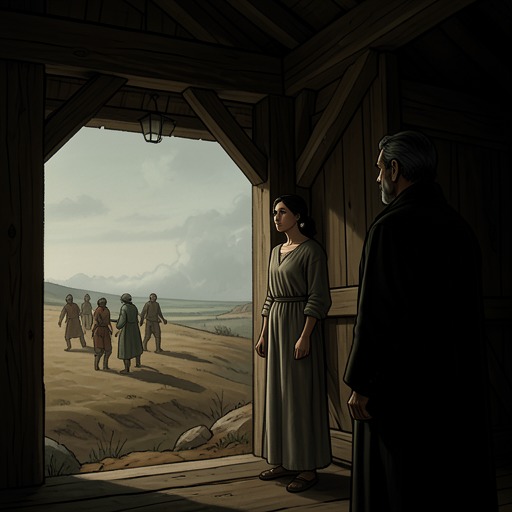
The crisis at Pointe du Lac culminates when the enslaved people discover that Louis and Lestat are not ordinary mortals. Their gathering around the house turns the plantation’s secrecy against itself. Inside, Lestat’s blind father is frightened and unable to understand the voices and disturbances around him. Louis forces Lestat to reassure the old man and tell him that he holds nothing against him, but Lestat then abandons him in panic.
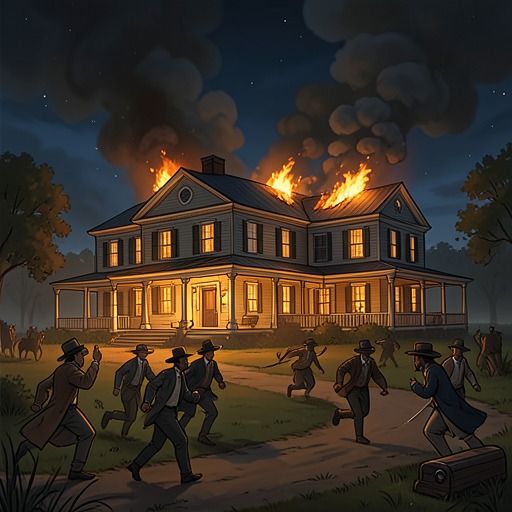
Louis kills the blind man without feeding on him. He opens the wound only enough to ensure that the old man will die, because he cannot bear the thought of allowing his own dark hunger to consume him. This controlled death is followed by a far less restrained attack outside. As the enslaved people flee, Louis joins Lestat in pursuing them, and the power of the vampire becomes unmistakable. Lestat leaves ruin and death behind him so that no coherent account can be made of the night.
Louis then returns to the house and sets fire to Pointe du Lac. The flames consume the magnificent parlor and the material identity of the plantation’s prosperous master. The fire is dangerous even to the vampires, and there are roughly fifty-five enslaved people scattered across the grounds, many of whom may flee toward Freniere plantation or Bel Jardin plantation. Louis has no intention of remaining until dawn and loads his coffin into a carriage before leaving with Lestat.
The destruction does not simply erase a residence. It ends Louis’s attachment to the legal, familial, and economic identity embodied by Pointe du Lac. He leaves behind the house, the plantation’s public respectability, the concealed deaths, and the role of prosperous master. The estate survives in memory as a beautiful and violent origin point: the place where Louis’s love of landscape and art is formed, where his guilt is born, where his vampirism is initiated, and where the old self is finally reduced to ashes.
Narrative and Thematic Significance
Pointe du Lac is a threshold space between cultivated society and swamp wilderness, mortal household and vampire lair, inherited wealth and supernatural mobility. Its galleries, oratory, bedrooms, slave cabins, river road, and surrounding swamps organize successive changes in Louis’s identity. The plantation begins as a site where he manages human affairs, becomes the stage on which he witnesses and commits killing, and ends as a pyre that releases him into the wider world.
The estate also concentrates the novel’s tension between beauty and violence. The harpsichord, rosewood furniture, jasmine, wisteria, cypresses, and moonlit gallery give Pointe du Lac an almost ceremonial aesthetic richness, but that beauty is inseparable from indigo production, enslaved labor, coercive management, and concealed death. Louis’s later claim that he respects life more deeply as a vampire does not cancel the plantation’s history; instead, it makes the gap between his ethical self-scrutiny and the institution supporting his life more visible.
As a remembered location, Pointe du Lac remains more than a lost property. It is the geography of Louis’s first irreversible choices: failing Paul, accepting Lestat’s offer, witnessing the overseer’s death, learning to kill, rejecting Lestat’s tutelage, confronting the suspicions of the enslaved community, and burning the house. Its destruction is therefore both an act of escape and an admission that the past cannot be purified. The plantation’s physical disappearance does not end its power; it becomes the foundational landscape against which Louis measures every later home, journey, relationship, and return.